Documents for life abroad · Reviewed 6 October 2026
Polish citizenship by descent: documents from parents and grandparents
Documents for Polish citizenship by descent need to connect you to your Polish parent, grandparent or earlier ancestor and support the citizenship history. Start with birth and marriage records, name changes and any Polish identity papers already held by the family. This guide helps identify gaps before you order replacements.
Documents for Polish citizenship by descent: a starting checklist
- Your identity and birth: current identification and, if born abroad, a full birth certificate naming your parents.
- Parents and grandparents: relevant birth, marriage and Polish identity records that connect each generation.
- Changed names: marriage or name-change documents explaining differences between records.
- Civil status: the relevant marriage, divorce or spouse’s death record for your own circumstances.
These categories come from the Polish consular citizenship-confirmation checklist for the USA. The authority may require further evidence; this is a starting inventory, not a universal list proving eligibility.
For missing Polish civil records, choose the birth certificate or marriage certificate service. For the proceeding itself, read about confirmation of Polish citizenship.
What are you trying to prove?
Separate three questions in your notes: who your ancestor was, how you are related, and what evidence exists about Polish citizenship. A birth record can establish a family relationship without answering every question about citizenship. Avoid treating a Polish surname or a birthplace on today’s map as a complete legal assessment.
The US consular checklist mentions civil records, parents’ and grandparents’ documents, name-change evidence and a full foreign birth certificate with parents’ names. These are examples of supporting evidence, not a promise that the same bundle suits every family.
If your main question is which procedure applies, first read confirmation, recognition and granting of citizenship. Here the focus is preparing a readable family file.
Build the family chain, one generation at a time
Begin with yourself and work backwards. For each person, record the name at birth, later surnames, date and place of birth, marriage details and the document that connects that person to the next generation. Keep both parents visible even when the enquiry follows only one side of the family.
- You → your parent: which record names that parent?
- Your parent → your grandparent: which record identifies the grandparent?
- Your grandparent → the earlier ancestor: is the relationship documented, or only remembered?
For example, if your grandmother appears under her married surname on your father’s birth certificate, put her marriage record beside her birth record. Label this as a link to check; do not silently change the name in a scan. A neat file makes a discrepancy easier to resolve, but neatness alone does not establish eligibility.
Which Polish documents should you look for first?
Make an inventory before buying anything. List Polish passports, identity papers, civil certificates, military papers and official correspondence held by the family. Record what each document actually says, which authority issued it and whether you hold an original, a copy or a photograph. Do not describe every old identity paper as a Polish passport.
A practical inventory has four columns: person, document, date, unanswered question. A grandparent’s document might help with nationality, while another record establishes a birthplace or maiden surname. Asking “which fact remains unproved?” is more productive than collecting every possible certificate.
Historical records may be in archives; more recent civil records may require a civil registry enquiry. Identify the relevant Polish civil registry office before sending several requests to unrelated offices.
Create a dated timeline alongside the family tree
A family tree shows relationships. A timeline shows the sequence of events. Include births, marriages, moves abroad and known citizenship-related events, using dates from the records whenever available. Keep “approximately 1930” visibly different from a date proved by a certificate.
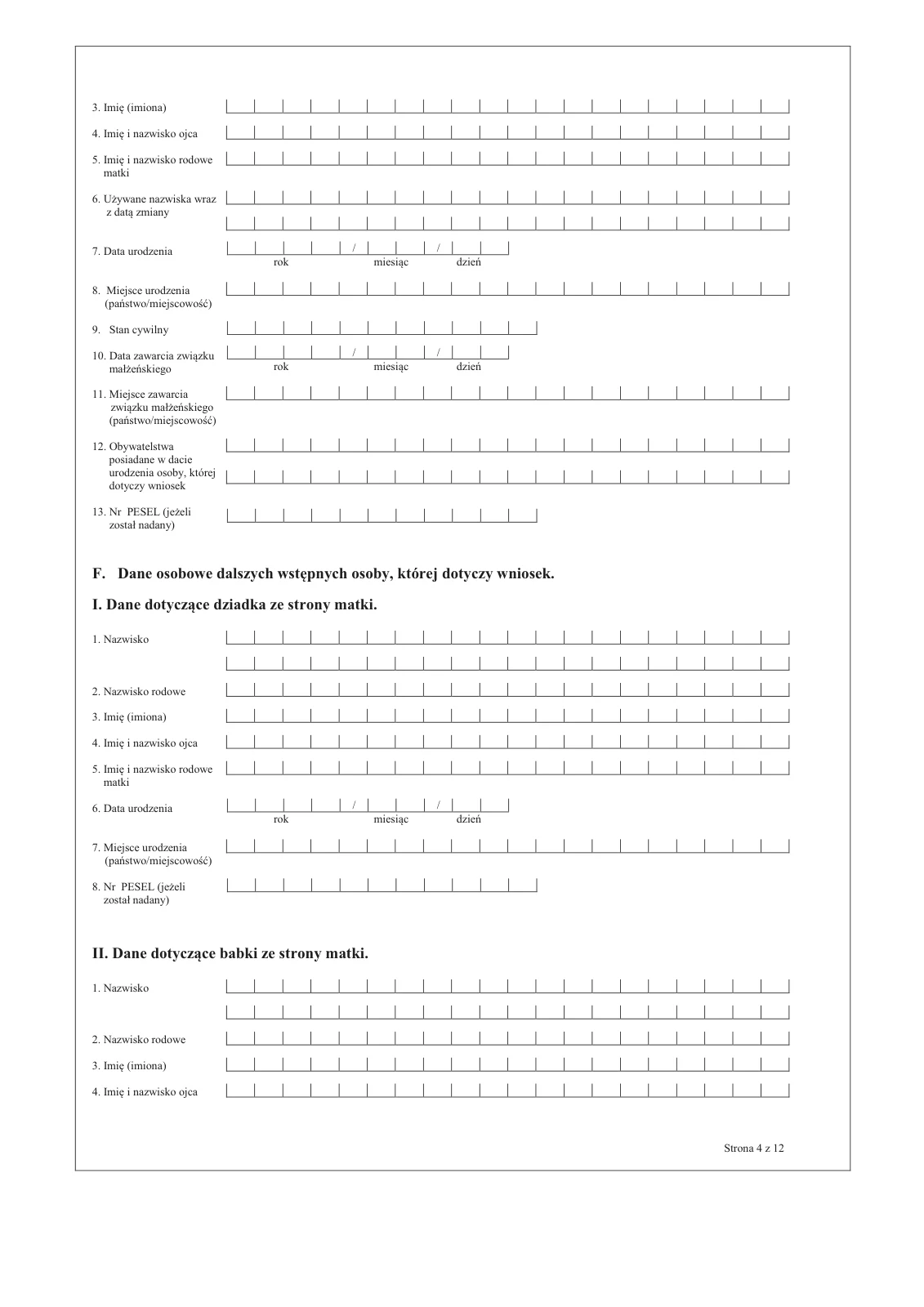
Where the form asks about another citizenship or an earlier proceeding, collect the underlying record rather than guessing from a family recollection. The blank official form illustrated here shows why identities and dates need to be organised together. It is a preparation aid; the competent authority assesses the legal effect of the events.
Useful notes are precise: “I have the certificate but not the full file”; “the spelling differs between two records”; or “the date is an estimate supplied by a relative”. These notes help identify the next targeted search.
How to handle missing names, places and records
Write down every spelling exactly as found, including diacritics. Add a separate column for possible variants. When a place name has changed, preserve the historical wording and note the modern location if you can establish it. Two towns with the same name require more than a surname to distinguish them.
If all you know is a town and an approximate birth year, start with the guide to searching Polish birth records online. Keep the archive reference and the scan number when you find a possible match. An index entry is a lead to inspect, not a substitute for the underlying record.
Do not arrange translations of a large collection until the evidence gaps and required versions are clear. Separate locating a record, obtaining an acceptable copy and translating it into distinct tasks.
Prepare a file that someone else can understand
- One family tree with a clearly marked line of descent.
- One timeline, with uncertain dates labelled.
- A folder for each person, containing complete document images.
- A list of discrepancies and missing records.
- A record inventory showing originals, copies and where each item came from.
Keep reverse sides and pages with annotations. Use file names that identify the person and document, not just “scan-final”. For an initial review, explain the question you want answered: whether a record can be traced, which relationship needs evidence, or which procedural route appears relevant. This allows the work and price to be agreed around a specific task.
Common mistakes that delay a citizenship file
- Skipping a generation. Every link between you and the ancestor needs its own record; one impressive historical document cannot replace a missing step.
- Treating every Polish document as citizenship evidence. Birth and marriage records prove family links. Passports, citizenship decisions, military or residence records may help with citizenship history. Label each document by what it proves.
- Using an unsourced family tree as evidence. A tree is a map for the search, not proof.
- Ordering apostilles and translations too early. Settle spelling and date differences first: some need a new certificate, an archival record or a formal correction of the Polish record before any certification work.
Common questions
Does my grandparent’s Polish birth certificate guarantee citizenship?
No. It may help establish identity and family relationships; the citizenship question requires assessment of the relevant facts and documents.
Should I order every ancestor’s certificate immediately?
Start with an inventory and the missing links. Agree which records are needed before commissioning a broad search.
Is this the same as applying for a first passport?
No. Evidence preparation, any citizenship-confirmation proceeding and a passport appointment are separate stages.
Review the gaps in your family document file
Describe the document you need, what you already hold and the point you want to resolve. We confirm the scope and price after case review, before paid work begins.
Explore document supportOfficial sources and further reading
- Act of 2 April 2009 on Polish citizenship (ustawa o obywatelstwie polskim)
Checked on 6 October 2026. Follow the receiving authority’s current instructions for your individual document and procedure.