Documents for life abroad · Reviewed 6 October 2026
Polish birth records online: how to find your ancestors’ documents
The best starting point is usually a place and an approximate date, not a surname alone. This guide shows how to turn a family clue into a record you can inspect, identify and request in the right form.
Write down the clues before opening a search engine
Create a short research note for the person you are tracing: name and variants, approximate birth year, parents, siblings, religion if known, and the place as written on surviving papers. Keep the source of each clue alongside it. A relative’s recollection and a dated official record should not carry the same certainty.
Search one person and one event at a time. If you are tracing a grandmother’s birth, a sibling’s record or the parents’ marriage may help identify the correct locality. Treat that as a lead to test, not proof that every same-surname family in the area is yours.
The Polish State Archives recommend beginning with the family archive and examining dates, places and religious affiliation to guide enquiries.
Check the historical place name and record-keeping context
A town may appear under different spellings or names in documents from different periods. Preserve the original wording in your notes and add possible modern equivalents separately. Identify the wider district or parish when possible; a village name alone may not distinguish several similarly named places.
Do not assume that every record relating to someone described as Polish is now held within today’s Polish borders. Work from the event’s location and the institution that created the record. Where the available evidence is incomplete, describe the uncertainty explicitly before commissioning a search.
For a concrete request, “birth around 1895, parents named on this later marriage record, locality written as…” is more helpful than “all records for the Kowalski family”.
Use Szukaj w Archiwach to locate the collection
Szukaj w Archiwach is an official route to archival descriptions and available digital material. The State Archives’ database guide explains that the service includes civil and parish-related records alongside other collections. A collection description is useful even when you cannot immediately open a scan.
Search the locality, then narrow the results by the institution or record type and the years covered. Read the collection title carefully: a marriage book is not a birth book, and a surviving volume may cover only part of the period you need. If there are scans, note the order of pages and look for registers or headings that help you navigate.
Archive searches take time and good Polish. If you would rather have the record found for you, we identify the registry or archive, request the record and deliver the certificate.
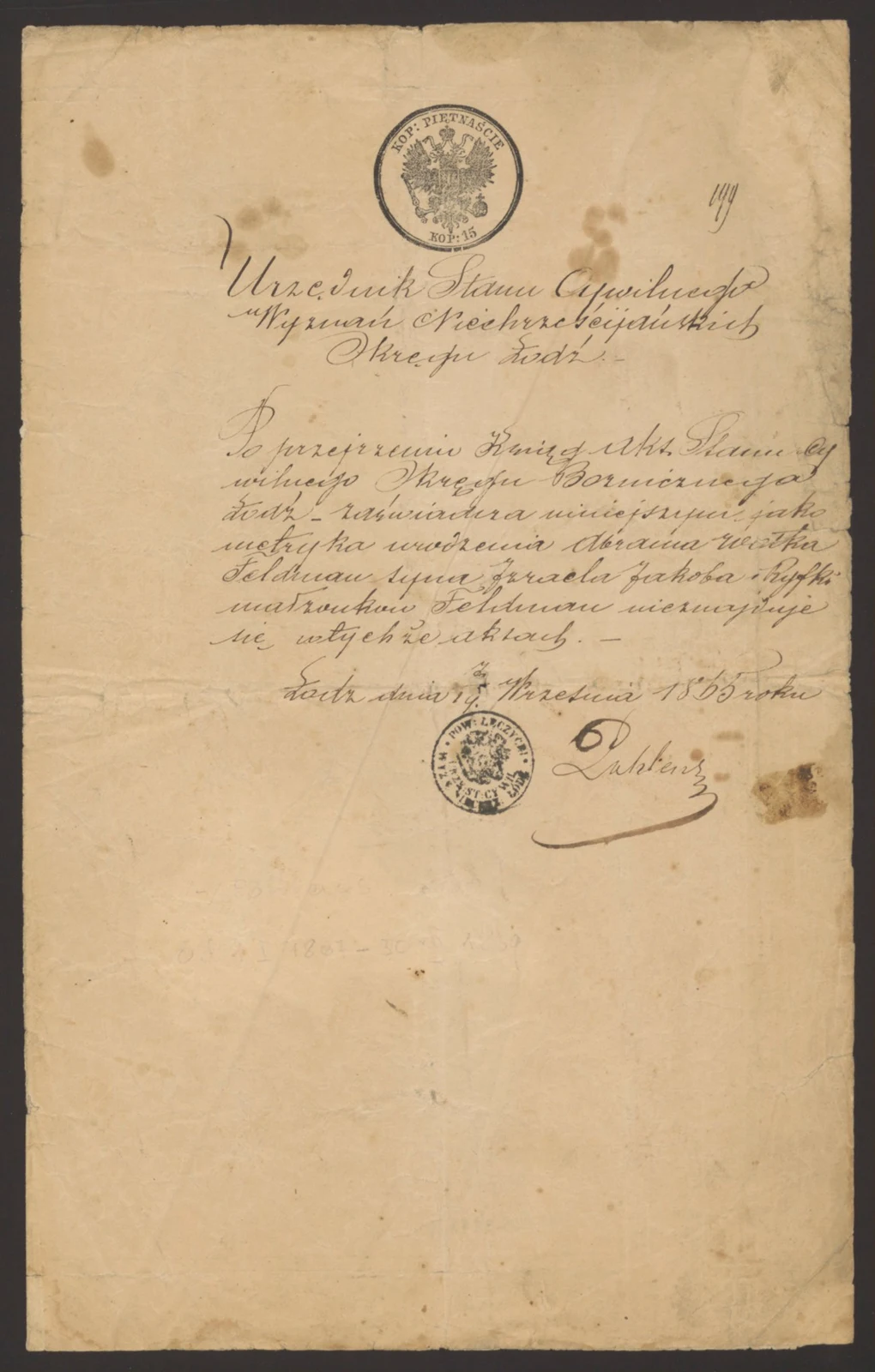
An index entry is a lead; the scan supplies context
Indexes can make a large collection easier to search, but a short entry may omit details or contain a reading error. When a scan is available, inspect the full entry and nearby headings. Record the entry number, names as written, date and what you can actually read. Mark uncertain handwriting instead of silently filling the gaps.
The historical birth-related certificate illustrated here comes from the National Library’s Polona collection. It shows why the document title and issuing context matter: a certificate concerning a birth record is not necessarily the original register page. Use it as an exercise in reading context, not as a template for a current civil certificate.
Do not infer citizenship solely from an archive hit. Genealogical relationships, identity and citizenship evidence answer related but different questions.
Is the record held by an archive or a civil registry office?
The State Archives advise checking the territorially relevant archive for birth records older than 100 years and marriage or death records older than 80 years. These are useful search thresholds, not a guarantee that every record has transferred or is online. Confirm the actual custodian and surviving coverage.
For a more recent civil record, use our civil registry office guide. If an archive describes a collection but the scan is unavailable, retain the reference and ask about access to that specific item. A missing online image does not by itself prove the record never existed.
Keep parish and civil records clearly labelled in your inventory. Ask the receiving institution what evidence it accepts before assuming a religious record and a current civil certificate are interchangeable.
Save a usable reference and choose the document you need
- Archive or institution name.
- Collection title and reference or shelfmark.
- Book or unit title and the years it covers.
- Entry number and scan or page reference.
- Stable catalogue link and your reading of the relevant names.
Decide whether your goal is family research, a current official certificate, or evidence for a particular proceeding. A downloaded scan may be sufficient for your own notes while the receiving authority may require an acceptable certified document. Confirm the required format before ordering or translating it.
For modern certificate formats, read full, abridged and multilingual Polish certificates. For ancestral citizenship evidence, continue to the family document checklist. A good next request identifies the missing fact and the record already found.
Common questions
Are all Polish birth records searchable by surname online?
No. Digital coverage and indexing vary; use locality, dates and collection descriptions as well.
Is a downloaded scan automatically a certified birth certificate?
No. Establish what the receiving institution requires and request the appropriate version.
Does finding a Polish ancestor’s birth prove I am a Polish citizen?
No. It may support family research or an evidence file, but citizenship requires a separate assessment.
Plan a targeted search for the missing Polish record
Describe the document you need, what you already hold and the point you want to resolve. We confirm the scope and price after case review, before paid work begins.
Explore document supportOfficial sources and further reading
- Act of 28 November 2014 on civil status records (Prawo o aktach stanu cywilnego)
Checked on 6 October 2026. Follow the receiving authority’s current instructions for your individual document and procedure.