Employment & ZUS Records · Reviewed 17 October 2026
Records from a closed Polish employer
A closed employer does not necessarily mean that every personnel record disappeared. Start with the employer’s legal identity, locate the records custodian and ask for the evidence your receiving institution actually needs.
On this page
Identify the legal employer, not only the workplace
Start with the exact name and address shown on an old employment certificate, contract, insurance booklet or payslip. Add your employment dates and the name you used at the time. A factory, shop or branch can have a different name from the legal entity that employed you.
The Zachodniopomorskie Voivodeship Office’s guidance begins with this identification step and explains how records may pass to a successor or another custodian. It is useful national search guidance; its local storage arrangements do not mean every Polish employer’s records are held in Szczecin. Official starting point for a closed-employer search.
Find out who now holds the records
Check whether the company still exists under another name or whether a successor took over its activity. If only a branch closed, begin with the company’s head office. For a closed entity, look for the named custodian and verify the company address and the years covered before requesting personal documents. State Archives: locating employment documentation.
Use the official tools as leads, then confirm the particular holding with the organisation listed:
- State Archives in Warsaw: employer and records-custodian search
- ZUS: database of liquidated or transformed employers
- State Archives: further routes for employment records
Search with distinctive parts of the employer’s name and compare the town or address. If an entry is promising, save the result and ask whether it covers your dates. A familiar company name by itself is not enough to identify the right file.
Say which evidence is required
Write down the question the receiving institution needs answered. Is it the employment period, the work performed, earnings, or a missing copy of a previously issued employment certificate? Include the authority’s request so the custodian can identify the relevant documents.
Do not assume that a records custodian can issue or correct a new świadectwo pracy simply because it stores an old personnel file. Ask what it can provide from its holdings and whether that output meets the purpose. State Archives guidance distinguishes stored documentation from the employer’s role in correcting an employment certificate. Official explanation of stored personnel and payroll records.
For a pension enquiry, ask the pension institution which evidence it will consider. Our guide to Polish pension records helps organise that request; it does not replace the institution’s assessment.
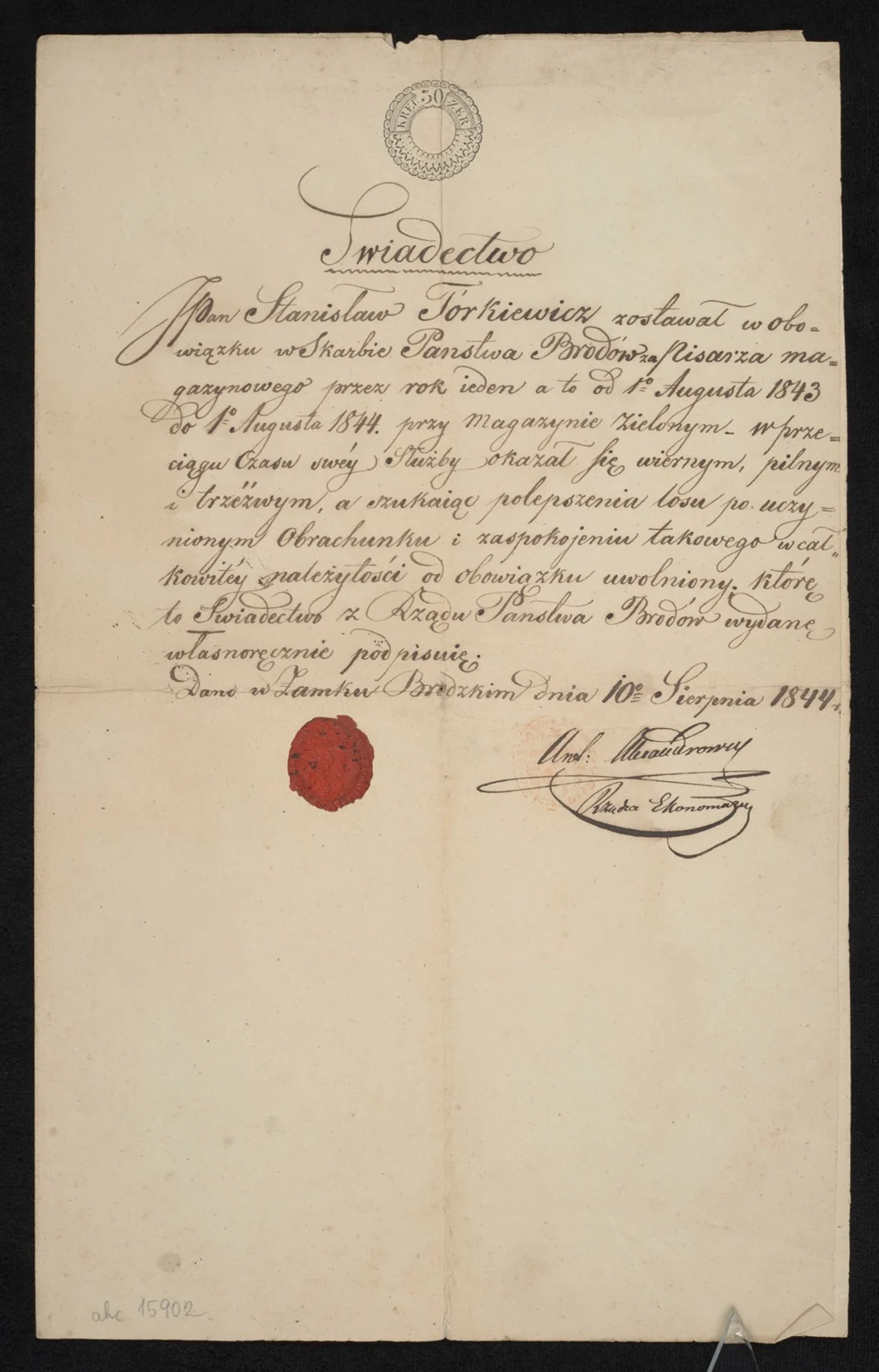
Historical example: an employment certificate for Stanisław Turkiewicz, dated 10 August 1844. It illustrates how a worker, issuer and date were recorded. It is not a modern employment-certificate template or a ZUS form.
Polona · Biblioteka Narodowa · Public domain. Resized and converted to WebP.
Prepare a focused request from abroad
Use a short covering message and a clear list of the records requested. Start with enough information to establish that you have found the right custodian. Ask how it verifies identity, handles an authorised representative and supplies copies before sending identity documents or originals.
- Your current name and the name used during employment.
- The full legal employer name, address and branch or workplace.
- Approximate start and end dates, with any known job title.
- The document or evidence requested by the receiving institution.
- Any file reference or earlier correspondence.
- The country where you live and the required delivery format.
Ask the custodian to confirm the scope, any charge and the method of delivery. Keep the request and response together. If a representative will handle the work, confirm the authority or permission required for that particular request.
What if the records cannot be found?
A missing database result does not establish that the records were destroyed. Check former names, addresses, a successor and the dates covered. If the custodian confirms a gap, record exactly which material and years are missing rather than describing the whole employment history as untraceable.
Personnel and payroll records have retention rules and may not all survive. The State Archives advises contacting ZUS about other evidence where employment documentation cannot be obtained. Do not substitute a guessed salary or assume that one surviving document proves every point of a pension claim. State Archives: missing records and next steps.
Before commissioning a search
Separate three tasks in your instructions: identifying the employer, locating its records, and requesting the evidence required. Agree what the search covers and what report you will receive if it does not locate the file. This makes it easier to decide the next step without repeating enquiries.
For example, a person who worked at a branch that has closed may first need the surviving head office, while someone employed by a dissolved company may need a records custodian. Neither route should be chosen from the workplace name alone.
Need help tracing Polish employment records?
Describe the former employer, employment dates and the evidence you need. We identify the appropriate employer, archive or ZUS route and confirm the scope and price before paid work begins.
Official sources and further reading
- Voivodeship Office: where to start an employment-record search
- State Archives: employment documentation and records custodians
- ZUS: liquidated or transformed employers database
Guidance checked on 17 October 2026. Availability depends on the employer and surviving records. The receiving institution decides which evidence it accepts.